

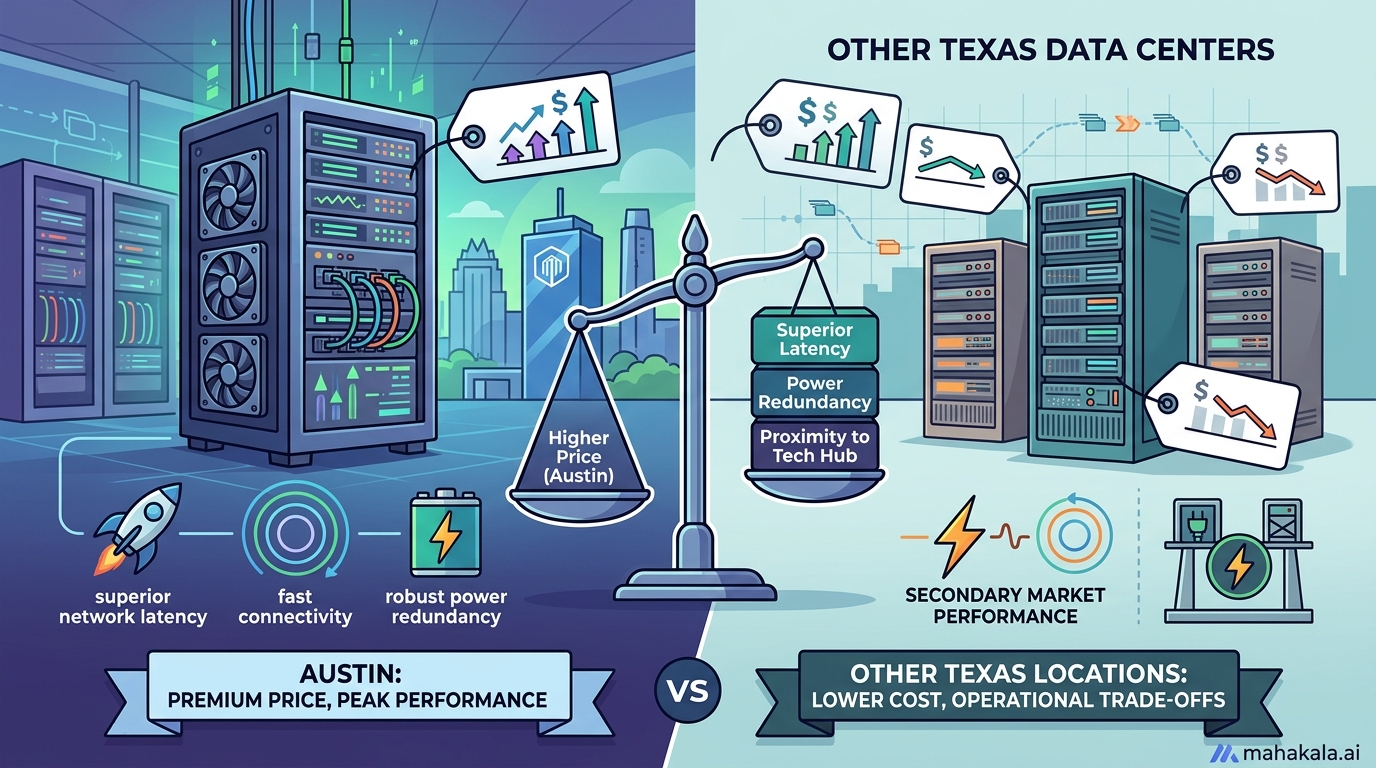
Austin dedicated server hosting typically commands a premium over other Texas locations due to high demand and advanced infrastructure. However, this cost is often offset by superior network latency, robust power redundancy, and proximity to major tech hubs. For businesses prioritizing performance and reliability, the slight price increase in Austin is frequently justified by the operational benefits it provides compared to secondary markets like Dallas or Houston. For additional details, review the mahakalaai com.
Market Dynamics in Austin
For teams using local-first AI platforms like Mahakala.ai, the proximity to high-speed network nodes in Austin can significantly reduce hybrid escalation latency. This makes the city an attractive location for deploying sovereign AI workloads that require occasional cloud offloading. For additional details, review the .
Comparison with Dallas and Houston
Dallas benefits from its central location in the United States, offering balanced latency to both coasts. Houston, on the other hand, serves the energy sector and Gulf Coast operations effectively. Pricing in these markets is often more aggressive, appealing to cost-sensitive enterprises. Yet, users must evaluate whether the lower cost aligns with their specific performance requirements. For additional details, review the Customer Experience.
Infrastructure and Reliability Factors
Reliability is a critical component of dedicated server hosting pricing. Data centers in Austin are known for their Tier III and Tier IV certifications, ensuring high uptime and redundancy. These certifications require significant investment in power, cooling, and physical security. The cost of maintaining such standards is reflected in the pricing structure. For additional details, review the Frequently Asked Questions.
For AI developers, the physical location of the server impacts the efficiency of local processing. A dedicated server in Austin can serve as a robust node for running open-weight models locally. The stable power and cooling environments ensure consistent performance for compute-intensive tasks. This reliability is a key differentiator when evaluating hosting options across Texas. For additional details, review the About.
Network Latency and Connectivity
Network latency is a primary consideration for businesses choosing a data center location. Austin's connectivity to major internet exchange points provides low-latency access to a wide range of services. This is particularly important for applications that require real-time data processing. The city's network infrastructure is optimized for high-speed data transfer, reducing the time it takes for information to travel between servers.
Key Takeaways
- Austin dedicated server hosting typically costs more than in Dallas or Houston due to advanced infrastructure and high demand.
- The premium pricing in Austin is often justified by superior network latency, power redundancy, and Tier III/IV certifications.
- For AI workloads, Austin's proximity to major network nodes can reduce hybrid escalation latency for local-first platforms.
- Reliability and uptime are critical factors that influence pricing, with Austin offering some of the most robust facilities in Texas.
- Businesses should evaluate total cost of ownership, including bandwidth, support, and network upgrades, when comparing locations.
Frequently Asked Questions
Is Austin dedicated server hosting more expensive than other Texas cities?
What are the main advantages of hosting in Austin?
How does Austin compare to Dallas in terms of pricing?
Is Austin suitable for AI workloads?
What factors should I consider when choosing a data center location?
Consider latency, reliability, pricing, and network connectivity. For AI workloads, the proximity to major network nodes and the quality of local infrastructure are critical.
Conclusion
To explore how local-first AI can enhance your workflow, visit Mahakala.ai to learn more about our sovereign AI development platform. Learn more: mahakalaai com.