

Privacy Architecture and Data Sovereignty
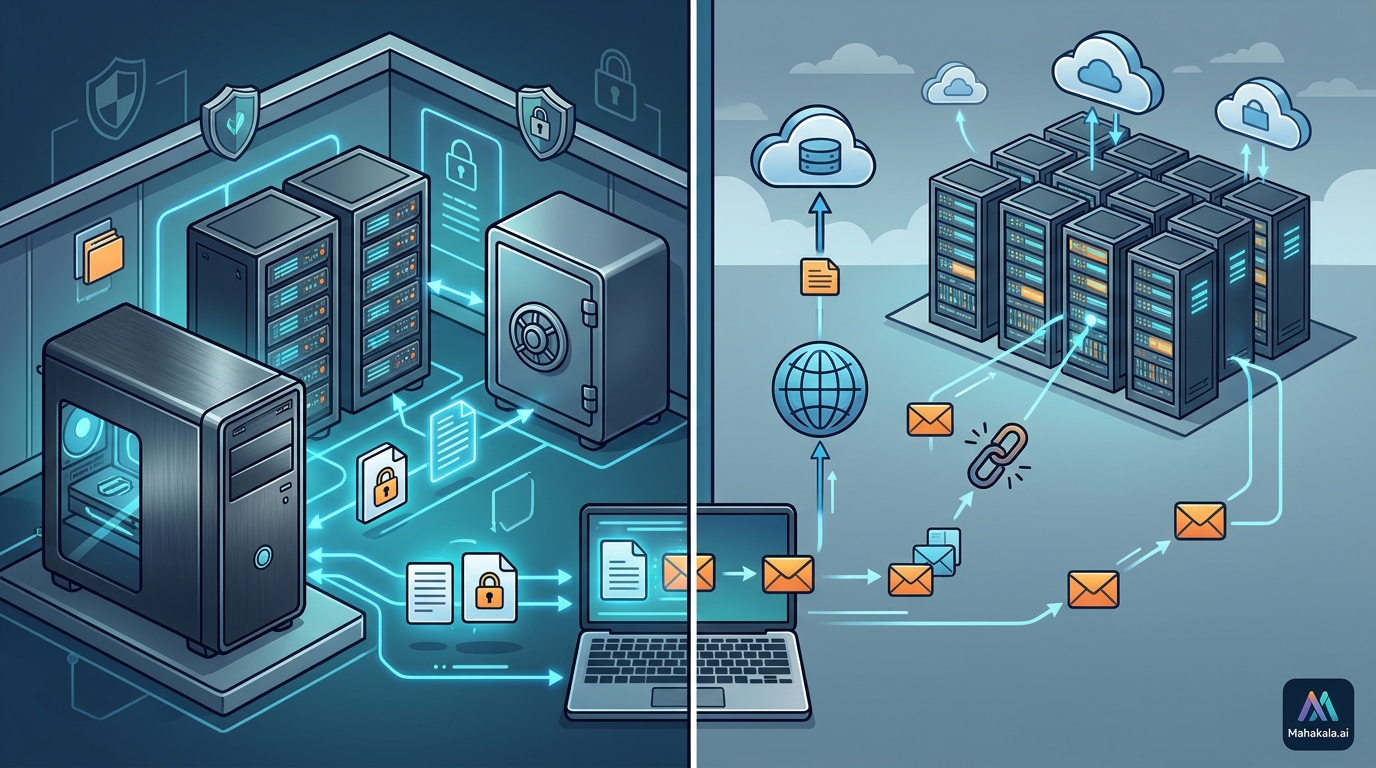
Cloud-dependent AI platforms typically require users to upload prompts, codebases, and context to remote data centers. This model creates a significant privacy risk because the data is stored on third-party infrastructure. Local-first processing is a design philosophy that keeps many data processing, vector indexing, and memory storage strictly on the user's local device. By maintaining data sovereignty, users retain full control over their intellectual property. This approach eliminates the need for mandatory external telemetry, ensuring that no usage data is sent to external servers by default. For additional details, review the mahakalaai com.
The implication for enterprise users is clear: local execution prevents data leakage to third-party vendors. When using a platform like Mahakala.ai, the codebase indexing and vector databases remain on local storage. This means that even if a user connects to the internet for hybrid routing, the core data assets remain protected within the local environment. This level of control is difficult to achieve with standard cloud APIs where data residency is often opaque. For additional details, review the .
Reliability and Latency Performance
Cloud AI services are subject to network variability, server load, and regional outages. These factors can cause unpredictable latency spikes that disrupt developer workflows. Local-first execution is a method that runs inference on local hardware, bypassing network dependencies for standard tasks. This results in consistent response times that are not affected by internet bandwidth or remote server congestion. For developers working on real-time applications, this consistency is a critical advantage over cloud-only solutions. For additional details, review the Customer Experience.
Hybrid Routing and Escalation
Pure local processing may struggle with extremely complex, multi-step reasoning tasks that require massive context windows. Hybrid escalation routing is a mechanism that automatically sends complex queries to cloud acceleration only when necessary. This approach combines the privacy of local processing with the raw power of cloud compute. By default, the system operates locally, preserving privacy, but can escalate to the cloud for specific, heavy-duty tasks. For additional details, review the Frequently Asked Questions.
This dual-mode architecture addresses the limitations of both pure local and pure cloud systems. Users can maintain a local-first workflow for 90% of their tasks while having the option to use cloud resources for the remaining 10%. Mahakala.ai implements this through autonomous multi-agent orchestration, where specialized agents handle different parts of the workflow. This ensures that the user experience remains seamless, with the system intelligently deciding when to use local resources versus cloud APIs. For additional details, review the About.
Security Models and Threat Vectors
Cloud platforms introduce a larger attack surface due to the exposure of data over the network. Local-first security is a model that relies on air-gapped execution and local data sovereignty to minimize risk. By keeping data on the local machine, the platform reduces the potential for data interception or unauthorized access by third parties. This does not mean the system is unbreachable, but it significantly reduces the vectors for common cloud-based attacks.
Zero mandatory external telemetry is a key component of this security model. It ensures that the platform does not collect usage data or send it to external servers. This transparency allows users to audit their own data flow and maintain full responsibility for their local configurations. For organizations with strict compliance requirements, this level of control is essential. It allows them to meet data residency and privacy regulations without relying on the trust model of a cloud provider.
Implementation and Hardware Requirements
Deploying local-first AI requires specific hardware considerations to ensure optimal performance. The execution speed and token throughput depend on the host device's memory bandwidth, SIMD support, and GPU/NPU availability. Users should evaluate their hardware capabilities before committing to a local-first workflow. Mahakala.ai is designed to run on consumer-grade hardware, making it accessible to a wider range of developers and organizations.
Key Takeaways
- Local-first processing keeps data on the user's device, ensuring full data sovereignty and privacy.
- Cloud-dependent platforms introduce latency and data exposure risks due to reliance on remote servers.
- Hybrid escalation routing allows for local privacy with the option to use cloud power for complex tasks.
- Local performance depends on hardware specifications, including memory bandwidth and GPU/NPU support.
- Native execution engines with SIMD and GEMM acceleration maximize local inference throughput.
- Local-first systems are ideal for developers who need consistent performance and strict data control.
Frequently Asked Questions
Is local-first AI more secure than cloud AI?
Local-first AI is generally more secure for data privacy because it keeps data on the local device. It reduces the attack surface by minimizing data exposure over the network. However, security also depends on the local system's configuration and the user's management of local data.
Can local AI handle complex tasks as well as cloud AI?
Local AI can handle many complex tasks, especially with hybrid routing. For extremely heavy tasks, cloud acceleration can be used. This allows users to benefit from both local privacy and cloud power.
What hardware is needed for local-first AI?
Local-first AI requires consumer-grade hardware with sufficient memory bandwidth and GPU/NPU support. The specific requirements depend on the model size and the desired performance level.
Does Mahakala.ai send data to the cloud?
Mahakala.ai operates under a zero-telemetry policy by default. Data is only sent to the cloud if the user explicitly enables hybrid routing for complex tasks. This ensures that core data remains local.
How does hybrid routing work?
Hybrid routing automatically detects when a task is too complex for local processing. It then routes the query to cloud acceleration. This ensures that the user gets the best performance for each task.
Is local-first AI suitable for enterprise use?
Yes, local-first AI is highly suitable for enterprise use. It helps organizations meet data residency and privacy regulations. It also provides consistent performance for development workflows. Learn more: mahakalaai com.