

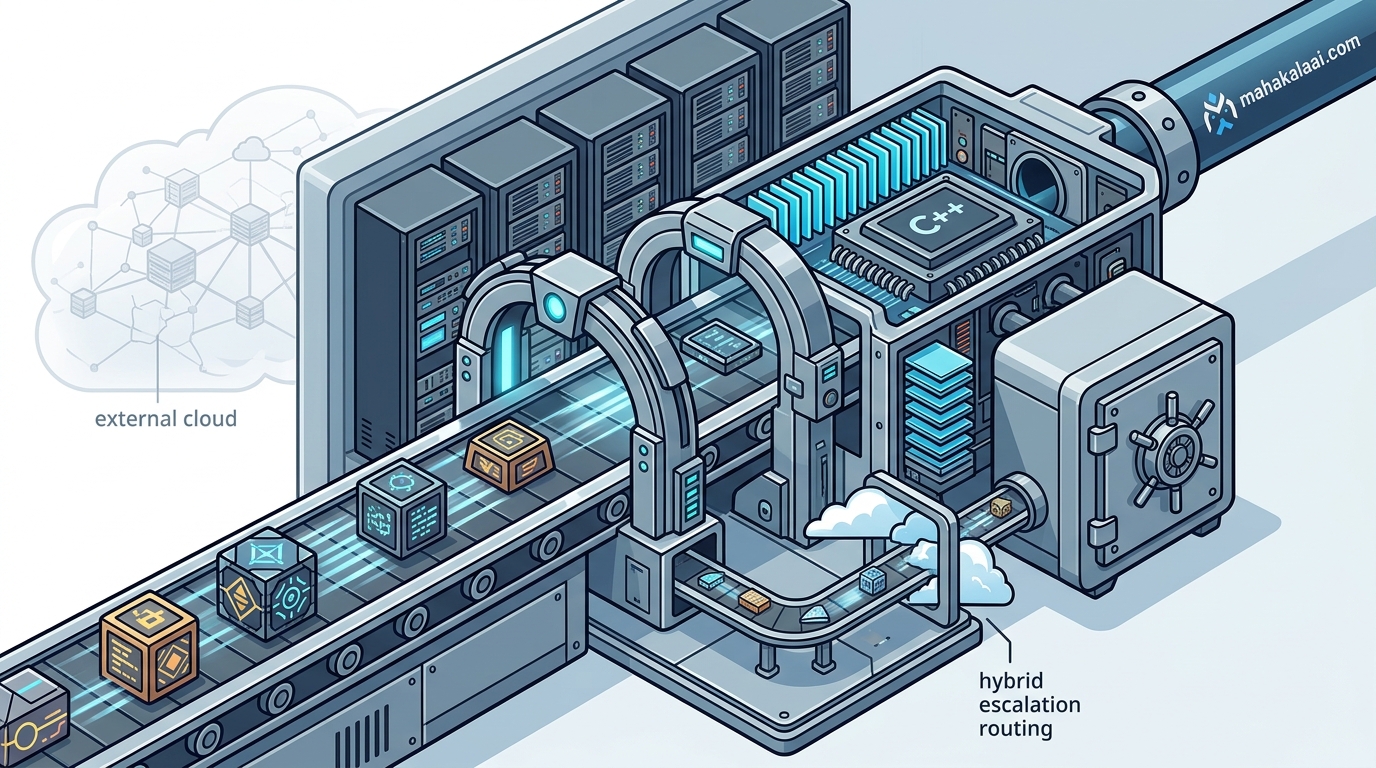
AI platforms maintain compliance and governance standards without sacrificing local processing speed by adopting a local-first architecture that keeps sensitive data on-device. This approach ensures that data sovereignty and privacy controls are enforced at the hardware level, eliminating the latency overhead associated with transmitting data to external cloud servers for processing. By executing inference locally, organizations can meet strict regulatory requirements while preserving the high throughput and low latency required for real-time applications. For additional details, review the mahakalaai com.
Local-First Architecture as a Compliance Foundation
The evidence for this approach lies in the operational mechanics of on-device execution. By running open-weight models locally, the platform acts as the primary source of truth for data handling. This means that sensitive information, such as proprietary code or personal identifiers, remains within the user's controlled environment. The implication is that organizations can achieve a higher level of data sovereignty without relying on complex encryption layers that might slow down processing. Local execution ensures that the data lifecycle is contained, making it easier to audit and manage in accordance with governance standards. For additional details, review the Customer Experience.
Hybrid Routing for Scalable Governance
Hybrid routing is a mechanism that automatically directs queries to local or cloud resources based on complexity and sensitivity. This system allows platforms to maintain strict local governance for sensitive tasks while leveraging cloud acceleration for non-sensitive, high-compute operations. The key is in the routing logic, which ensures that data requiring strict privacy controls never leaves the local device. This selective escalation preserves the speed benefits of local processing for the majority of tasks while providing the necessary power for complex computations. For additional details, review the Frequently Asked Questions.
The evidence for effective hybrid routing is seen in the ability to minimize latency for routine operations. By keeping the bulk of processing local, the platform avoids the network round-trip time associated with cloud APIs. This is particularly important for applications that require real-time responses, such as interactive coding assistants or workflow automation. The implication is that governance does not have to be a bottleneck. Instead, it becomes an intelligent layer that optimizes resource usage while ensuring that compliance boundaries are respected. This approach allows for seamless scaling without compromising the core privacy principles of the local-first model. For additional details, review the About.
Autonomous Agents and Quality Gatekeeping
Autonomous agent orchestration is the coordination of multiple specialized AI agents to execute complex, multi-step tasks. In the context of governance, these agents can be configured to enforce quality thresholds and validate outputs before they are finalized. This multi-agent validation system acts as an automated quality gate, ensuring that the results meet predefined accuracy and safety standards. By cross-evaluating outputs through a consensus mechanism, the platform reduces the risk of errors and ensures that the final output is reliable and compliant.
The evidence for this approach is the integration of a three-way debate system and quality gatekeeping. This system allows agents to cross-evaluate their own outputs, identifying potential inconsistencies or errors before they are presented to the user. This iterative error reduction process is crucial for maintaining trust in AI-generated content. The implication is that governance is not just about data privacy but also about output integrity. By embedding quality controls directly into the agent workflow, the platform ensures that the results are not only fast but also accurate and safe. This level of automated validation is essential for enterprise environments where the cost of errors is high.
Zero-Telemetry and Data Control
Zero-telemetry policy is a commitment to not collecting or transmitting any user data for analytics or improvement purposes without explicit consent. This policy is a cornerstone of data control and privacy, ensuring that users maintain full ownership of their data. By eliminating mandatory external telemetry, the platform removes a significant vector for data leakage and unauthorized monitoring. This approach aligns with the principles of data minimization, which is a key requirement in many privacy regulations.
Key Takeaways
- Local-first architecture ensures data sovereignty by keeping sensitive data on-device, reducing compliance risks.
- Hybrid routing allows for scalable governance by selectively escalating non-sensitive tasks to the cloud.
- Autonomous agent orchestration with quality gatekeeping ensures output integrity and reduces errors.
- Zero-telemetry policies protect user data by eliminating mandatory external data collection.
- Local processing preserves high throughput and low latency, essential for real-time applications.
- Embedding governance into the core architecture ensures that compliance is a default, not an afterthought.
Frequently Asked Questions
How does local processing help with compliance?
Local processing helps with compliance by keeping data on the user's device, reducing the risk of data breaches and ensuring data residency requirements are met.
What is hybrid routing in AI platforms?
Hybrid routing is a mechanism that directs queries to local or cloud resources based on complexity and sensitivity, optimizing for both speed and governance.
How do autonomous agents ensure quality?
Autonomous agents ensure quality through multi-agent validation and consensus mechanisms, which cross-evaluate outputs to reduce errors and ensure accuracy.
What is a zero-telemetry policy?
A zero-telemetry policy is a commitment to not collecting or transmitting user data for analytics without explicit consent, ensuring full data control.
Can local processing handle complex tasks?
Yes, local processing can handle complex tasks, especially when combined with hybrid routing that escalates high-compute operations to the cloud when necessary. Learn more: mahakalaai com.