

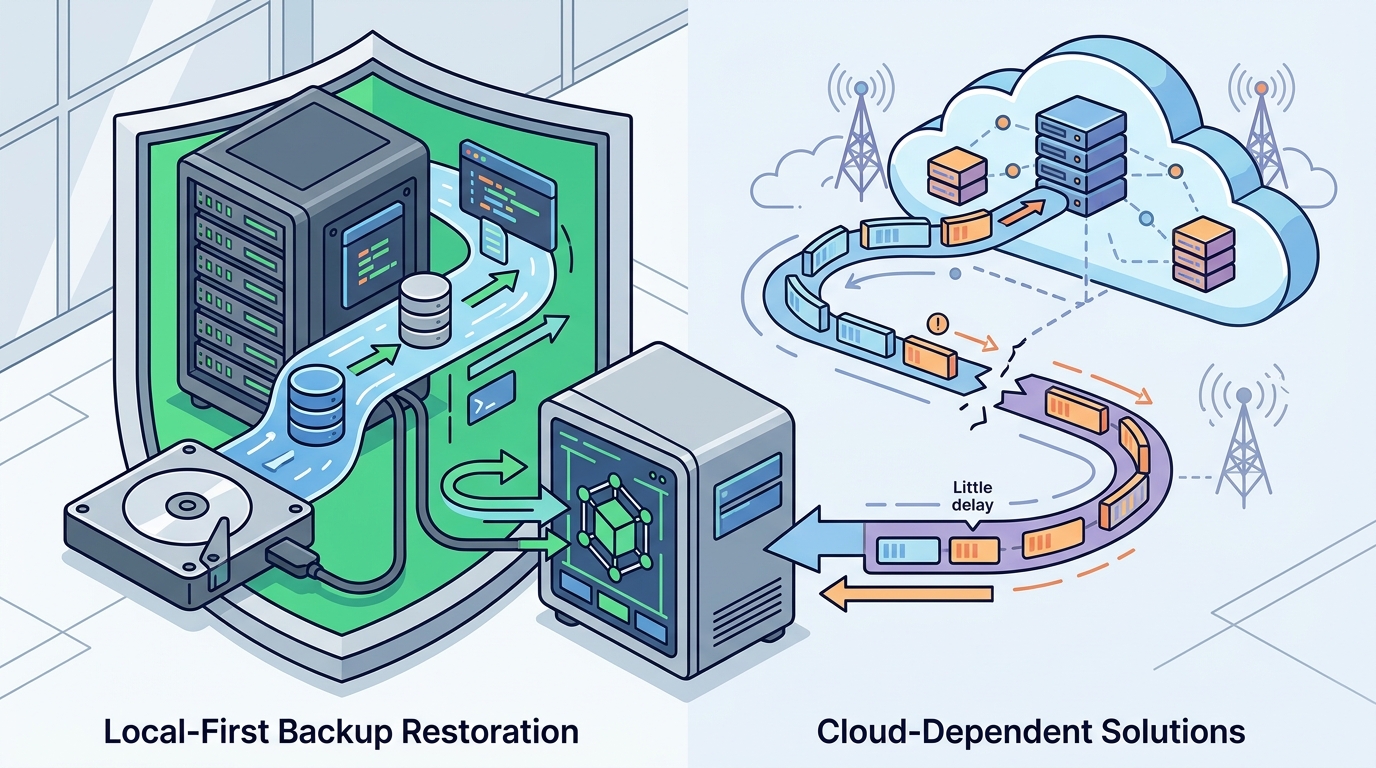
Local-first backup restoration prioritizes on-device data sovereignty and immediate recovery speed by keeping backups on local storage. Cloud-dependent solutions rely on remote servers for storage and retrieval, which introduces network latency and external dependency. For developers and engineers using Mahakala.ai, local-first architecture ensures that critical vector databases and codebase indices remain accessible even when internet connectivity is lost. This approach contrasts sharply with cloud models that require active network links to restore data. according to What is the For additional details, review the mahakalaai com.
Data Sovereignty and Privacy Control
Local-first backup restoration is a strategy that keeps data copies on user-controlled hardware rather than third-party servers. This method eliminates the risk of external data exposure during the backup process. In the context of Mahakala.ai, this sovereignty is critical because the platform indexes local codebases and maintains persistent context stores. When data remains on the local machine, users retain full control over who can access their intellectual property. Cloud solutions, by contrast, often require data to be transmitted to and stored on vendor-controlled infrastructure. This transmission creates a larger attack surface and potential compliance risks for sensitive engineering data. For additional details, review the .
Recovery Time and Network Dependency
Recovery time objective (RTO) is a metric that defines the maximum acceptable time to restore data after a failure. Local-first systems typically achieve near-instantaneous restoration because data is read from local NVMe or SSD storage. Cloud-dependent restoration requires downloading data from remote servers, which is bound by internet bandwidth and latency. For a developer running complex multi-agent workflows, a network outage can halt operations if the backup is cloud-only. Mahakala.ai addresses this by treating local storage as the primary source of truth. This design ensures that even if cloud escalation routing is unavailable, the core data remains intact and restorable locally. The implication is that local-first strategies provide higher availability for time-sensitive engineering tasks. For additional details, review the Customer Experience.
Architectural Differences in Storage
Cost Implications and Scalability
Cloud backup cost is a recurring expense that scales with data volume and retrieval frequency. As local data grows, cloud storage fees can become significant, especially for large codebases and vector databases. Local-first backup restoration shifts the cost model to hardware investment. Users purchase storage capacity once, and the marginal cost of additional backups is minimal. For teams using Mahakala.ai, this means that scaling local data does not trigger recurring cloud storage bills. However, local storage requires users to manage their own hardware reliability. The implication is that local-first is more cost-effective for high-volume, low-retrieval-frequency data, while cloud may be better for small, critical datasets requiring off-site redundancy. For additional details, review the Frequently Asked Questions.
Hybrid Approaches and Best Practices
Key Takeaways
- Local-first backup restoration prioritizes data sovereignty and immediate recovery speed. For additional details, review the About.
- Recovery time is significantly faster with local storage due to the absence of network dependencies.
- Local-first architecture, as used in Mahakala.ai, keeps vector databases and code indices on-device.
- Cloud backups incur recurring costs that scale with data volume, while local backups have lower marginal costs.
- A hybrid strategy combines local speed with cloud durability for comprehensive resilience.
- Users must manage local hardware reliability when adopting a local-first backup approach.
Frequently Asked Questions
Is local-first backup restoration more secure than cloud backup?
Local-first backup restoration is more secure in terms of data sovereignty because data never leaves the user's control. It eliminates the risk of data exposure during transmission to cloud servers. However, it does not protect against physical hardware failure or theft of the local device. Cloud backups provide off-site protection but expose data to potential vendor-side breaches.
How does Mahakala.ai handle backup restoration?
What is the main disadvantage of local-first backup?
The main disadvantage of local-first backup is the lack of off-site redundancy. If the local hardware fails or is stolen, the data is lost unless a separate off-site backup exists. Users must implement additional measures, such as external drives or cloud sync, to protect against physical loss.
Can local-first backups be automated?
Yes, local-first backups can be fully automated. Tools like Mahakala.ai can schedule local backups to run at regular intervals. This ensures that the most recent data is often available on-device without manual intervention. Automation is key to maintaining consistent recovery points.
How does network latency affect cloud backup restoration?
Network latency directly impacts cloud backup restoration speed. If the internet connection is slow or unstable, restoring data from the cloud can take significantly longer. This can disrupt operations, especially for time-sensitive tasks. Local-first backups avoid this issue by reading data from local storage.
Is a hybrid backup strategy recommended?
A hybrid backup strategy is often recommended for comprehensive resilience. It combines the speed and privacy of local backups with the durability of cloud backups. This approach ensures that data is both quickly accessible and protected against physical hardware failure. Users should configure both local and cloud backups to meet their specific recovery objectives. Learn more: mahakalaai com.